





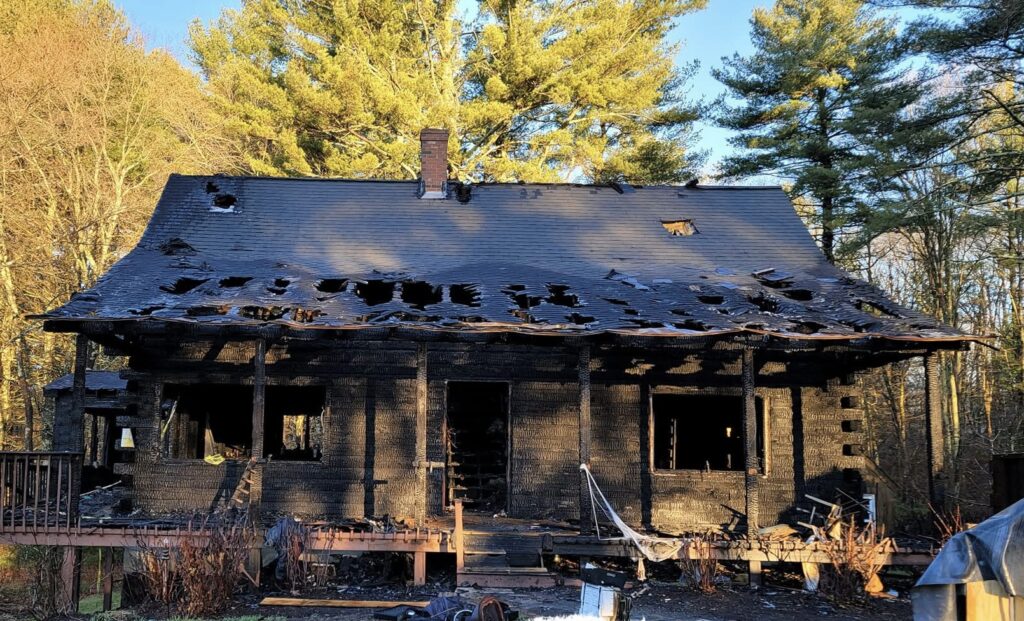
BURRILLVILLE – In September of 2022 Betsy Alper and Bruce Powers’s home on Joslin Road caught fire. No one was home at the time and the blaze would quickly engulf the structure, ripping through logs and the family’s possessions to ultimately leave the house uninhabitable.
In the years that have since passed, the couple has worked to rebuild their lives and this week – with emotions that at times were still raw – they discussed the incident, hoping to help save others from a similar tragedy.
According to investigators, the fire was likely caused by a defective battery on a cordless Dyson vacuum. The six cell lithium ion battery pack had been replaced under warranty when the original failed, arriving as expected in a Dyson box.
“The ignition source for this fire is most likely the exothermic heat produced by the degrading batteries,” the final report from the fire notes.

“I was surprised by how quickly they figured it out,” said Alper. “They very quickly asked me ‘Did you have a cordless vacuum cleaner?'”
A member of the Board of Canvassers, Alper was out readying town polling places for a primary election the following day when the blaze first started. She was first to arrive on scene – before firefighters – and knew something was wrong when she saw one of her dogs running down the street to greet her.
She notes that only around 20 minutes had passed since her sons left the home around 4 p.m., but the first floor of the structure was somehow already fully ablaze. Neighbors reported hearing an explosion.
“I knew at that moment that the house would be destroyed,” she said.
Part of the problem was that fire from lithium ion batteries is known to spread quickly and burn intensely, making it notoriously difficult to extinguish. Numerous reports on Saferproducts.gov and elsewhere document similar explosions of the vacuum batteries.
“The failure of a battery pack is a high energy event involving the release of pressure and flammable gases,” the report notes. “The cells can reject at multiple distances and directions causing multiple fires to occur.”
A representative from Dyson did not respond to questions from NRI NOW this week about product safety.
On Joslin Road, furniture was reduced to ash. A cell from the pack was found to have traveled some 30 feet from where the vacuum had been left charging, spreading flame to tables, chairs, walls and flooring along the way.
“It’s like lava from a volcano,” Powers said.
“It destroyed everything,” said Alper. “Everything we had.”
The couple would have to live in a trailer on the property while rebuilding their home of more than 20 years from scratch. Among the few possessions still recognizable in the debris was a Captain America shield, a gift Powers had received from his sons years earlier. He hung it to a tree beside the wreckage, where it would serve as a symbol of the family’s resilience through their recovery.


They say it was the kindness of friends, neighbors and others in town that kept them going when times were tough.
“Everyone was so nice,” said Alper.
Two dogs and one cat escaped from the fire, but another cat had remained in the house and needed emergency care. Many in town donated to a fund hoping to help save the pet, but it ultimately succumbed to the injuries.
The family’s new house was complete by May of 2023, but possessions were replaced more slowly, and of course some, like photos and a painting given to Alper by her late aunt, were irreplaceable. The couple saved money wherever they could, finishing some of the work on the new house themselves.
“People think their insurance will cover it,” said Alper. “It cost way more than we got from insurance.”
“It was very emotional,” Powers said. “I never thought it would take so much time, so much work, so much energy and be so painful to recover from a fire.”
Now, the couple hopes to save others from the relatively unknown danger. In researching the issue, they’ve learned that problem affects not just vacuums, but many cordless items, commonly including electric bikes and Roombas. Powers notes that the products that destroyed his home can still be found on the shelves when he shops at a local Target.
“Everyone has these in their houses – they’re everywhere,” he said. “If people are going to use them, they should at least be aware.”
Alper noted that people often comment that they’ll just stay home when they charge the batteries – but that could actually put them in more danger from exploding debris.
“It’s like a bomb,” she said. “It’s a misconception that you could stop it if you’re there.”
The family has rebuilt their home – with a few small modifications that were long on their wish list – and life, for the most part, is now back to normal. The shield still hangs on a tree outside the classic log home, surrounded by lush grounds of perennial flowers – saved from post-fire reconstruction with the help of friends.
And they have a message for others.
“If you need to use these batteries, use an extension cord and charge everything outside,” Betsy said.



Sorry for your loss. I cannot imagine the pain you endured.
We purchased a Dyson Cordless Stick Vacuum recently. I am curious if the replacement battery was OEM? Thank you.
Thank you, Jim.
The battery was one that we had received from Allstate and it was under warranty. We had it for four months and it had arrived in Dyson box leading us to assume that it was a a battery from the manufacturer.
Dyson customer service is notorious for not responding and delaying request for replacement batteries. Customers end up waiting months and months until they have to make a decision whether they are going to get a new vacuum cleaner or get a third part or bad battery and then Dyson blames the third-party batteries.
These type of fires also happen with electric bike, batteries, and other cordless vacuum cleaners, such as Roombas
Betsy
Very informative! This is an important article that may prevent tragedy for others. Thank you to these homeowners for thinking of ways to help others following what had to have been a very traumatic several years. May their healing continue!
I’m puzzled by this. Shouldn’t the homeowners’ insurance company have gone after Dyson to at least recoup the amount they paid out? And couldnt the homeowners themselves go after Dyson themselves if the fire marshall determined that was the cause?
Hi JoshW. We actually discussed this with the homeowners and they did go after Dyson, even hiring lawyers in hopes of a class-action suit. Dyson fought it and was able to avoid responsibility. They told me one tactic the company used was saying that they needed to send their own representative to investigate the scene – but waiting more than four months to actually do so. I’m also not sure if the “most likely” language in the fire marshal’s report may give them an out, but I imagine it could have an effect. The family has more details of how this all shook out but I think with a large company like this, the cost of litigation that will actually prove they are responsible ultimately makes it not worth the effort and expense.
Excellent question Josh. I am the homeowner. Initially, the insurance company did try to go after Dyson. But Dyson‘s tactics are to delay delay delay. It took months for them to respond to the insurance companies inquiry. All while we were living in hotels and then a trailer. By that time they finally did respond, the house had been cleaned out and was scheduled for demolition. The insurance company chose not to pursue because it would’ve costed them more in legal fees and they were aware that Dyson would continue to delay.
We also engaged with a private law firm who worked on the case for over a year. Ultimately, they decided to not go forward because. while we had a solid case, Rhode Island’s law only allows compensation for physical injuries, not pain and suffering. This meant that they would’ve had to invest a great deal of money in our case to take on Dyson, but they would not have gotten much in return. Even if they won a settlement that accounted for how much we had to pay above what the insurance covered they would not have been a profit for the attorneys.
Actually it is advised to NOT USE AN EXTENSION CORD….you must use the adapter and charge the batteries DIRECTLY into the wall socket when charging.
But if you absolutely must use an extension cord, keep it as short as possible so no voltage drops, and check all for any possible overheating….
Thank you for sharing this information!