





NORTH SMITHFIELD – A developer in the process of gaining approvals for construction of six houses along the Slatersville Reservoir has proposed a land swap with the town in hopes to square off his property.
Philip Godfrin received a positive recommendation from the Planning Board on the proposal earlier this month, and will now need members of the Town Council to approve the deal for his Slater Court project.

Godfrin plans to build six three bedroom houses along a roughly 10 acre stretch of the reservoir that his company, BB&G Associates, acquired in 2021, according to town property records. Town Planner Mark Carruolo said this month that a minor subdivision related to the project is pending in the town planning office.
“He would like to acquire a small lot that is surrounded by the subdivision on Main Street that was formerly a well water lot,” Carruolo told planners at their meeting on Thursday, Sept. 11.
Godfrin’s large, vacant wooded lot abuts two small town-owned properties, and the deal would see one of those – an 8,684 square foot space that holds a defunct town well – absorbed into his space.
“It’s an undersized parcel,” Carruolo said of the requested property. “It’s a very small, narrow lot.”
In exchange, Godfrin has offered the town 39,650-square-feet of land on the opposite side of his parcel, adjacent to another undersized town-owned space. The exchanged parcel, he suggested, could be merged with that .25 acre lot to create a town property that has both frontage and reservoir access.
“You’d end up with two reasonably rectangular lots that went from Main Street to the water,” explained Carruolo.

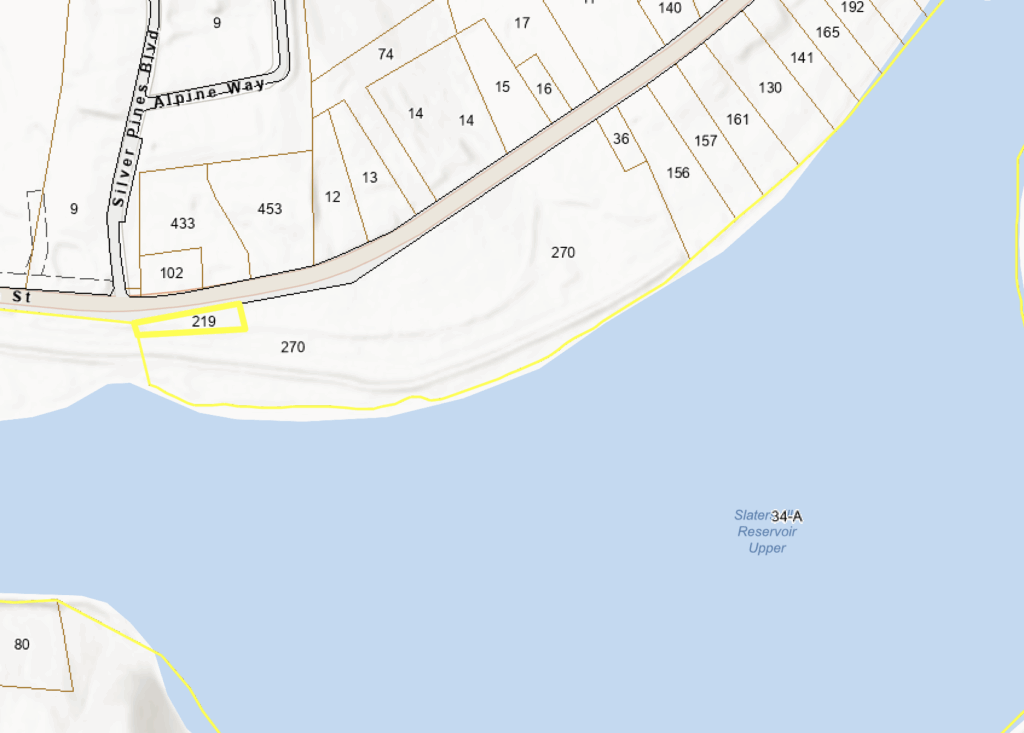
Godfrin told planners that the lot he’s hoping to receive, which is unused and currently under control of the Water Department, could only fit an 18-foot-wide structure as is under town zoning law.
“It’s rather impractical,” he said.
Of the trade, Godfrin added, “After discussions with the Heritage Association, they actually requested this piece of property so that they would have access to the water.”
“Reasonably, I think it’s a good exchange,” said Carruolo of the deal. “I think the town is getting the greater benefit of the property. I would support it.”
Godfrin said the heritage association has requested an easement to guarantee future access to the water.
“The Town Council may want a restriction,” said Carruolo. “They may not want one.”
Planner Jeffrey Porter asked to add consideration of a conservation easement to the planning recommendation.
“We don’t have a lot of open waterfront on that reservoir, which is one of the biggest assets in this town,” agreed Chairman Gary Palardy of the idea.
Planners unanimously passed a positive recommendation for the land swap adding that the council should consider an easement “to maintain access for future generations.”

The Town Council has not yet voted on the land swap, but at their meeting last week, councilors did approve a request by Water & Sewer Supt. William Descoteaux to add five of the buildings in Slater Court, with an address of 270 Main St., to the town’s water and sewer systems.
“The sixth lot will be dealt with after the five lots are approved,” noted documents included with the request. “We are planning to build on five of the lots right away.”




Just for clarification, I see the word Zoning, again the zoning board is left out. Remember the Solar overlay. Zoning was not asked their opinion. but yet we have a zoning board. For what? And that overlay is gone. I don’t see anyone protecting the reservoir. We do have a GAA status in that area. And groundwater overlay there.
I would hope that the town would allow access to this waterfront parcel to all residents of the town. Our previous Comprehensive Plan pointed out the benefits of our waterways as recreational space to be accessed by all residents. It would be nice to see this come to fruition and more access should be a guiding factor in all planning.
The items and sections you list reference the Planning Board giving Zoning relief. They do not have jurisdiction for zoning overlay districts. I’d suggest you reach out to the town solicitor and planner regarding the matter before running to AI to understand the extents of the law.
Potential Misalignment
If a town hasn’t updated its ordinances or processes to reflect UDR (e.g., still relying on separate zoning board reviews), it risks non-compliance, legal challenges, or delays in processing requests. Municipalities must ensure PBs are empowered, timelines are met, and public notification aligns with the new laws. For example, failing to integrate rezoning into PB-led reviews or ignoring the 60–120-day timeline could violate § 45-23-50.1.
New State laws dictate that the Planning Board not Zoning is the deciding board. The process the town is following violates state law.
Specifically, these two:
1. https://webserver.rilegislature.gov//Statutes/TITLE45/45-24/45-24-46.4.htm
2. https://webserver.rilegislature.gov//Statutes/TITLE45/45-23/45-23-50.1.htm
As of September 25, 2025, Rhode Island municipalities must adhere to updated zoning and land use laws that went into effect on January 1, 2024, particularly the Unified Development Review (UDR) process outlined in R.I. Gen. Laws § 45-23-50.1 and § 45-24-46.4. These laws streamline the process for handling requests to change zoning, integrating them into a more efficient, planning board (PB)-led framework. Below is how a municipality must now proceed with such requests, based on the legal changes and their implications.
Steps for Processing Zoning Change Requests
Initiation of the Request:
A zoning change request (e.g., rezoning, variance, or special-use permit) must be submitted as part of a project proposal, such as a subdivision or land development, or as a standalone rezoning request under the UDR framework.
If tied to a project (e.g., expanding operations), the request is reviewed under UDR at the master or preliminary plan stages, aligning with § 45-23-50.1.
Planning Board Review:
The PB is now the primary authority for reviewing and conditionally approving zoning relief, including rezoning, variances, and special-use permits, concurrently with project reviews (§ 45-24-46.4).
The PB must provide a mandatory advisory opinion on rezoning (§ 45-23-61) and can grant special-use permits or variances, eliminating the previous sequential review by separate zoning boards.
For earth removal or site/restoration plans, the PB reviews compatibility (e.g., assessing groundwater risks in residential areas) and can deny requests if incompatible, without grandfather status applying.
Public Hearing Process:
Public hearings are unified under UDR (§ 45-23-50.1(d)), shortening timelines to 60–120 days, compared to the longer, fragmented processes of the past.
The PB must notify and involve the public, ensuring transparency while adhering to the streamlined schedule.
Decision and Conditions:
The PB can conditionally approve zoning changes before the final plan, provided conditions are met (§ 45-23-50.1(b)(3)-(4)).
I wanted to make the same comment here as we did on Facebook. Maybe we are missing something and you can explain?
We haven’t fully looked into your statements but can tell you that many projects in NS have indeed appeared to be following the new law with unified plan review before the Planning Board. We’re unclear about your statements that they are not following the new law as this has been happening for some time
I can copy from AI too
The authority of planning boards in Rhode Island is primarily related to the preparation of the comprehensive plan, land development, and subdivision review.
According to Rhode Island General Laws, a city or town council, not the planning board, is responsible for adopting a zoning ordinance and map, which includes the establishment of zoning districts and, typically, overlay districts, under the Rhode Island Zoning Enabling Act.
However, the planning board’s role often includes:
* Advisory Recommendations: Planning boards are typically required to provide an advisory opinion and recommendation to the city or town council on all zoning matters referred to it, which would include the creation or amendment of a zoning overlay district (R.I. Gen. Laws § 45-23-61(b) and § 45-22-7(c)).
* Review and Approval of Development: Planning boards may be delegated the power, via local ordinance, to review and approve, approve with conditions, or deny specific development projects, including those within an established overlay district, especially if they involve major land development or subdivision (R.I. Gen. Laws § 45-22-7(c) and § 45-23-50.1). Some local ordinances explicitly state that development within a certain overlay district requires Planning Board review and approval (e.g., as a major land development project).
In summary, the power to approve and enact a new or amended zoning overlay district generally rests with the city or town council, but the planning board plays a critical role in providing a mandatory advisory recommendation and often has the power to review and approve specific development projects within the district.
There is always that one fly in the ointment!