




GLOCESTER – Help may or may not be on the way for teachers and aides recently laid off as a result of cuts in the Glocester Elementary School budget.
At a recent special Town Council meeting, the board agreed to send a resolution for a tax levy increase and supplemental tax. Currently Rhode Island law limits tax levy increases to 4 percent per annum. The recent approved budget was just that, including a 6 percent increase for local schools and a 2 percent increase for municipal services.
“Notwithstanding the increase in funding, the School Department in fiscal year 2026 will face a significant budget shortfall that will require the School Department to lay off teacher and teacher assistants and significantly reduce student services,” states the resolution. “The proposed School Department layoffs and reduction of student services will have a significant impact on student achievement, disciplinary behavior and the broader educational environment.”
The resolution requests permission to provide additional funding via a supplemental tax of not more than 3 percent to fund School Department operations and avoid a loss of critical town services. The resolution first has to be approved by the House and the Senate before being put to voters for approval in a referendum, possibly as early as September.
“We want to put it in front of the voters and see if they want to do this or not,” said Councilor Jonathan Burlingame, a former chairman of the School Committee. “I think this is the only way around it.”
“It will help immensely if this passes,” said School Committee member Beth Keeling.
“I appreciate the support of the Town Council members and their willingness to work collectively and collaboratively to support our elementary schools,” Supt. Renee Palazzo told NRI NOW. “If the funds are approved by the voters, it would allow us to recall and retain staff and if not approved, the school department would have to move forward with the approved reductions.”
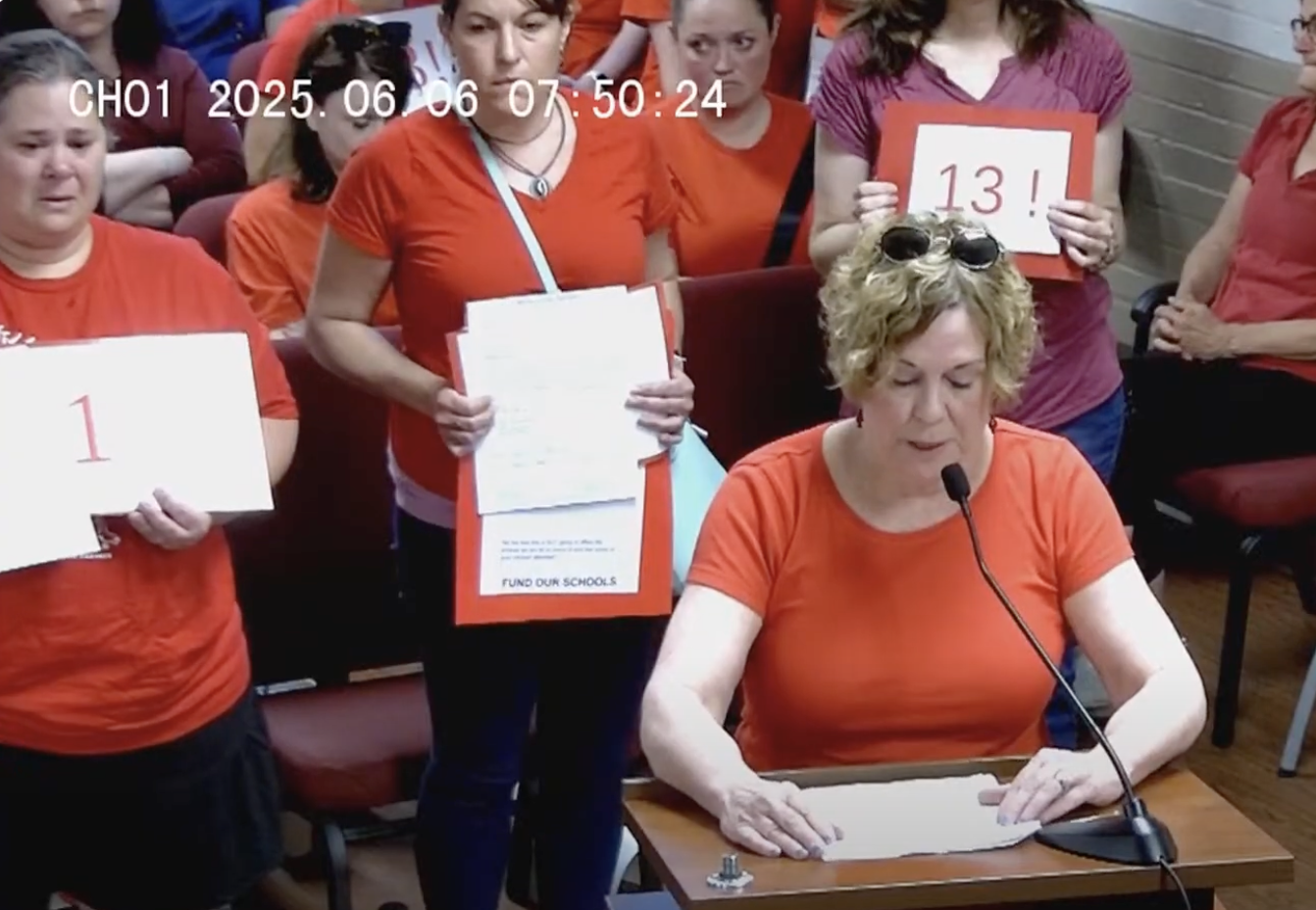
At present 13 aides and four teachers have received layoff notices, some of whom have worked in the school department for several years. At the recent Town Council meeting, teachers, aides and administrators showed up en masse to implore the council to do something. Longtime art teacher Erin MacPhee, who has taught in the district for 39 years, was one of the many teachers who spoke.
“I believe the schools belong to everyone in this town,” said MacPhee. “Even those citizens and taxpayers without children should see what our schools give to this town. That is why we are all here tonight. We are upset. We are worried. We are heartbroken.”
MacPhee went on to say she had, obviously, been a teacher for a long time and has seen the changes and problems over the years.
“I have seen the good, the bad, and the ugly,” said MacPhee. “I have never seen it this ugly.”
The school department, she said, has already been functioning with a decline in staff, doing more and more with less and less for years. MacPhee then handed out packets listing all the services and duties and extras that teachers do during the course of the school year, hoping, she said, that it would help convince the council to do something.
“I think what you will find is that taxpayers of Glocester truly get their money’s worth out of us,” she said.
Resident Jason Whitford, a 25 year Glocester Elementary teacher, pointed out that part of the problem was the regional school budget, which is voted on in March before the town budget. When the town budget is voted on in May, funds are already limited for both the elementary schools and municipal services.
“This results in a council and budget board and school department to create a budget with what is left to run the town,” he said.
Whitford added that 15 years ago then town Finance Director Thomas Mainville warned this day would be coming if something wasn’t done to change the way budgets were decided.
For many years there has been a battle between the local and regional school departments and the council for funds, he said. He accused the council of giving the local school department minimum increases over the years, contributing to the problem. He also added that the town has the sixth lowest cost per pupil in the state.
“For years we have been asked to do more and more with less and less,” said Whitford. “Now they are asking employees and school department to do more with practically nothing.”

Teacher Pat Sernezza discussed the impact it would have on education when 13 aides were laid off.
“Thirteen isn’t just a number,” she said. “It represents the many hardworking, dedicated, highly qualified and specially trained teacher assistants that will lose their jobs. Gone.”
The majority, she added, not only live in town but have children in the schools.
Palazzo told the council that this is not a case of we versus them, but a case of what can be done to help solve the problem.
“I just need us to keep open the conversation and discussion moving forward,” she said.
Town Council President William Worthy previously told NRI NOW that he was heartbroken after attending a recent School Committee meeting and learning about the cuts being proposed.
“The council took it as far as we could,” he said of trying to provide as much funding as possible. Unfortunately, the limits imposed by the state prevent any more monies being allocated for schools or municipal needs, he said.
Moving forward, if the resolution does pass, some changes need to be made, said Burlingame, including taking a closer look at expenditures. The turnover in finance directors in recent years may have had an impact, as well as the pandemic and a drop in school population, among other factors.
“The blame does not necessarily fall entirely on the schools,” said Burlingame. “It’s a lot of things that came together to cause this. They just need to pay a little more attention to the budgets, and the school committee really needs to pay more attention to that. I just wish they had kept a closer eye on things. I am hoping with this approval the schools can get a part-time business manager to help them keep up.
“It is tough having one person do both jobs,” added Burlingame of the municipal and school budgets. “I think that’s part of the problem. Going forward they just have to monitor things more closely.”
Editors note: An original version of this article attributed several of Councilor Burlingame’s quotes to Councilor Worthy. We apologize for the error caused by an editorial misinterpretation.



then it would seem as though people think they can just spend spend spend. somebody needs to be held accountable.
Dave, you put it exactly right. Thank you for your comment.
Councilor Burlingame indicated that the blame for the very poor financial condition of the Glocester schools is not entirely the fault of the School Committee (SC).
FY 23 school deficit was $981,000. What did the SC do, added $333,000 in operating expenses for the FY 24 budget, FY 24 school deficit was $357,000. What did the SC do, added $622,000
in operating expenses to the FY 25 budget. The FY 25 budget (current year) is projected to also run a significant deficit. Since FY 23 the Town has made $1,300,000 in supplemental appropriations to the schools, the schools have used $1,356,000 in their own funds, the state has increased aid by $200,000. All this funding is in addition to the school’s yearly funding from the Town and State. The SC has not paid any attention to their budget and are now in extreme financial difficulty. The school are three years in deficit so why the out cry now? Because there is now longer extra money the throw at the financial problem. The SC has to make hard financial decision and layoff might occur. For three year school employees did not care about deficits but with layoff there is now outrage. At the Town Referendum held in May a budget for FY 26 was passed. It did not fund the schools at a level that they requested but was
passed. It was $800,000 + short. How did people think this short fall was to be addressed. Only one way, layoffs! If you voted for that budget you voted for layoffs. The Town Council at their last meeting voted to increase taxes by an additional 3% for a total of 7% increase in taxes to pay for expenses in the FY 26 budget. They were very short on details and President Worthy would allow no public comment. How much in dollars is 3%? How much will the tax rate increase? Will this increase mean an additional $500-$1000 increase in taxes ? Do not know because Town Council did not or could not explain. There are three contract currently being negotiated with town employees. Seeing the increased funding for the SC do you think the unions will settle for less than the 4% that was given to Public Works? This increase of an additional 3% to the tax levy will have far reaching effects in the future. All because the SC did not pay attention to their budgets! But they are being rewarded. They do not have to worry about funding as all they have to do is go to the money pit, Glocester taxpayers!