




BURRILLVILLE – A research project that aims to see if a species of wasps can be used to prevent beetles from destroying all of the region’s ash trees has shown some small signs of promise, according to the organizations collaborating on an effort in Burrillville.
“Within this decade, we may lose all the ash trees on our protected properties,” said Burrillville Land Trust President Paul Roselli.
The town-based land trust has been working with the Rhode Island Department of Environmental Management and experts with the University of Rhode Island Biocontrol Lab on an Emerald Ash Borer study. The invasive species of beetles has made its way into northern Rhode Island and has the potential to wipe out all of the area’s ash trees.
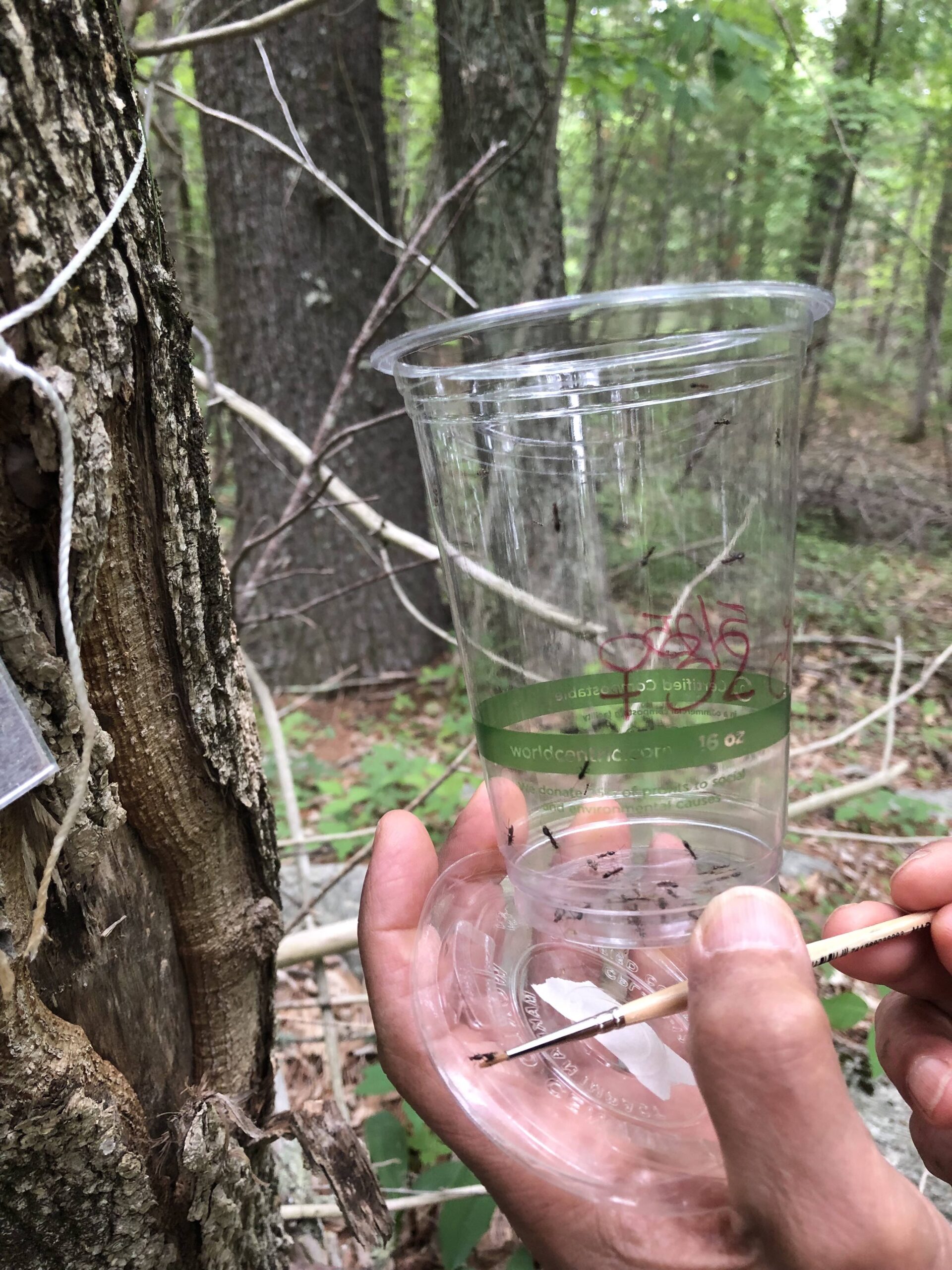
Around two years ago, the team working on the project released thousands of parasitoid wasps at the Edward D. Vock Conservation Area in Pascoag. The insects attack the larvae of beetle, and kill them before they can mature.
Now the experts are back at Vock to see if the parasitoid wasps survived the winter and what impact they are having on the Emerald Ash Borer.
Alana Russell, forest health program coordinator for RIDEM’S Division of Agriculture and Forestry noted that the Animal and Plant Health Inspection Service has a rearing program at a lab in Brighton, Mich. that is run by U.S. Department of Agriculture. APHIS provided the parasitoids and helps to make sure the right amount are available.
At the Burrillville property, 2,080 Spathius galinae, 2,098 Tetrastichus and 3,000 Oobius were released in 2023. The adult Spathius galinae, a very tiny wasp, attacks the larvae of beetle, and kills them before they can mature.
“This is an ideal number,” said Russell. “Many biocontrol programs are limited by the number of parasitoids available for release. Inundation is a good strategy – the more out there, the easier it is to find mates, and a better chance of gravid females and long term survival.”
Russell and her team are monitoring the Vock property and three other sites in northwestern Rhode Island. Now, they are checking to see if their wasps survived.
“Traps that were set out last year showed that some parasitoid wasps may have over wintered in this area,” she said. “We are still identifying the wasps that we caught. A measure of success can be if we find just one of the wasps we originally released.”

Other sites of interest by the URI team along Round Top Pond are showing signs of decline due to the EAB infestation.
The more common ash trees in Rhode Island are white ash, or Fraxinus americana; green ash or Fraxinus pennylvanica; and less common black ash or Fraxinus nigra.
“Two years ago we were hopeful that the release of over 7,000 parasitoid wasps could save our native ash trees,” said Roselli, who took part in the release. “We are hopeful that these creatures will help save these majestic ash trees from extinction.”



Just check out the area around Country View Golf Course. Lots of dying or dead ash trees
I have about 6 ash trees on my property and they have all died over the past few years. It’s too bad.
Hopefully the Ash trees won’t go the same way the Dutch Elms did years ago.