




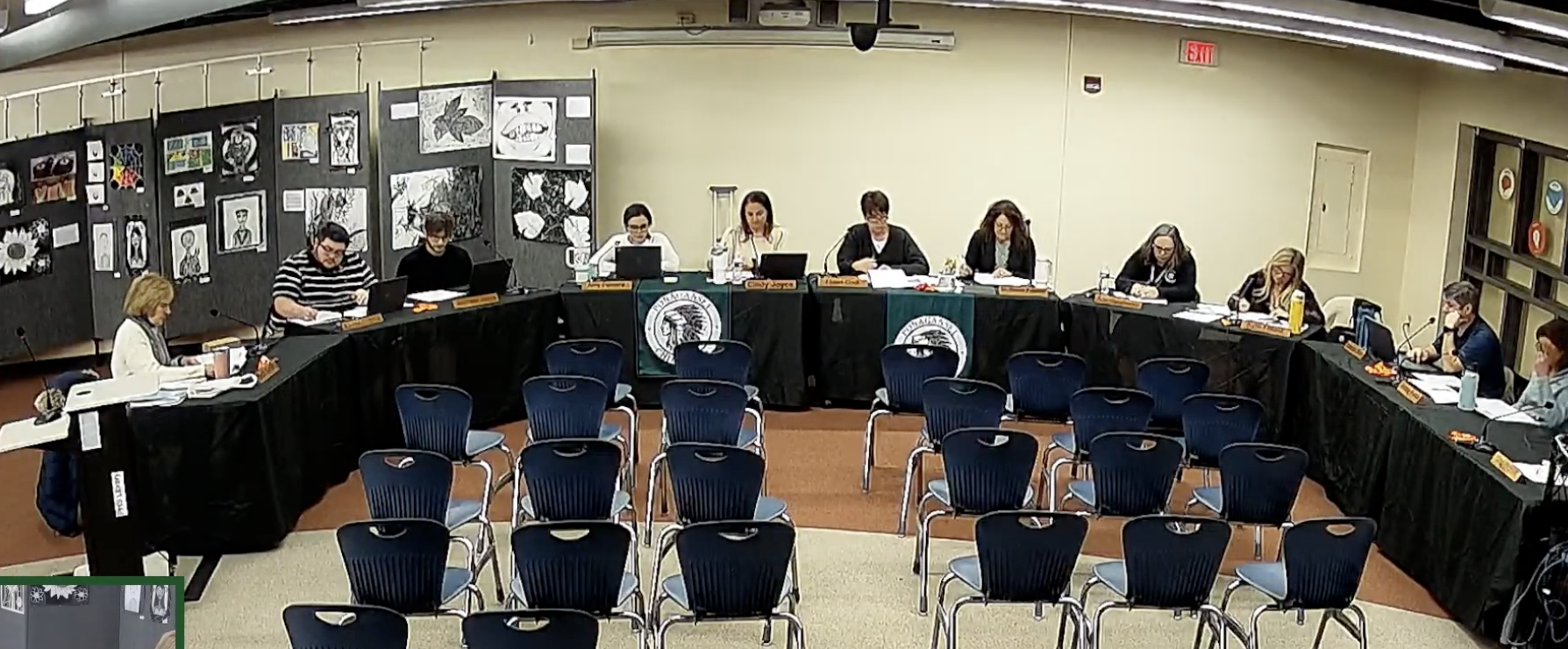
GLOCESTER – Noting that district clerk Kyle Fraatz is spending an abundance of time on a task that falls outside her job description, Supt. Renee Palazzo has asked the Foster-Glocester School Committee to approve a stipend for requests that fall under the state’s Access to Public Records Act.
Committee members unanimously approved a plan to add a stipend to Fraatz’s contract at the board’s last meeting, with the amount to be negotiated and come back for a final vote.

The decision comes just as one Glocester resident’s lengthy request led Attorney Gregory Piccirilli to estimate the charge for retrieval at more than $1.2 million.
“Kyle has been spending hours… beyond her job description,” said Palazzo. “She’s here all hours of the night trying to address these.”
Palazzo said that the number of requests the district receives has more than doubled in recent years, with just 40 submitted from 2015 to 2021, and 109 in the past “few years.”
“Everyone has the right to make these requests, however, the large volume that are coming in and the large amount of work that’s going into addressing these APRA requests has really consumed a lot of Kyle’s time,” she said. “It’s gone way above and beyond her job description.”
This week, resident Laurie Gaddis Barrett shared a response from the district attorney to a request she submitted in January that aimed to garner shared-service agreements governing IT systems, student data platforms, email hosting and records retention between the Foster-Glocester Regional School District and Glocester School District.

Gaddis Barrett’s roughly 200 word APRA submission aimed to avoid any potential loopholes by requesting copies of “any and all written agreements, memoranda of understanding, intergovernmental agreements, service-sharing agreements, contracts, or other formal or informal written instruments,” going back to 2020. It noted inclusion of “executed agreements, draft agreements, addenda, renewals, amendments, policies incorporated by reference, and any correspondence or records centrally maintained by district administration, legal counsel, finance, or information technology offices that memorialize or formalize such arrangements.”
The district asked for an extra 20 days to respond to the request – as covered by the records law – with a response sent on Wednesday, Feb. 18.

“The wording of your request is the most extensive and obtuse the district and I have ever encountered,” noted Piccirilli. “The District’s IT department has determined that it is likely that your request was AI-generated to capture the broadest possible terms and close every possible loophole.”
The attorney notes that IT ran targeted Google Vault queries aligned to the four subject areas. One, for “Agreement / Instrument” used the following query: (“contract” OR “agreement” OR “MOU” OR “memorandum of understanding” OR “intergovernmental” OR “service sharing” OR “shared services” OR “scope of work” OR “SOW” OR “master services agreement” OR “MSA” OR “statement of work” OR “renewal” OR “amendment” OR “addendum” OR “extension” OR “RFP” OR “proposal” OR “quote” OR “terms and conditions”) with a resulting count of 1,535,181 emails.
Piccirilli details five additional potential queries resulting in a total of 2,417,989 emails.
“Each of these emails (and the attachments) would have to be reviewed to determine if they are responsive to your APRA request. Any responsive emails would then have to be reviewed to determine if there is any information that the District is not allowed to release or that
is otherwise exempt from APRA disclosure,” wrote Piccirilli. “The District would also have to determine if such information may be removed by redaction or whether the entire email should be withheld. Finally, to the extent that emails should be produced with redaction, the District would have to redact each of these emails before production.”
The task, he estimates, would take 80,599.3 hours – and the APRA specifies that the district can charge $15 an hour with the first hour free resulting in a cost of $1,208,974.50.
“We recognize that these estimates are patently absurd, however, so is the language of your request,” the attorney added. “You are free to resubmit your APRA request with a narrower scope.”
For her part, Gaddis Barrett feels it was the district’s search methodology that created the volume, not the request itself, and said she found the attorney’s commentary “unprofessional, inappropriate and unnecessary.” She says the response was not a good faith effort to address her inquiry, noting the search was not time limited – but her request was.

Further, she said she’s submitted “countless” APRA requests with public bodies in the state.
“Whenever there’s a question or concern (rare) the public body has always reached out and said ‘this is how we are interpreting your request, it’s resulting in significant document returns, can you confirm our interpretation of your APRA request is correct before we continue?'” she said.
Either way, it seems such potentially broad-reaching requests resulted in discussion of the issue at the committee’s meeting on Tuesday, Feb. 3.
“They’re long so they require a lot of time to prepare them,” Palazzo said of recent submissions, noting that Fraatz is the “APRA coordinator” under district policy, but she has never been compensated for the role, and works until 6 or 7 p.m. each night.
Committee member Brendan Mara questioned if the cost of the stipend could be covered through fees charged for the service.
“It seems like we’re already kind of collecting for some of the larger ones,” he said.
Piccirilli responded that fees received would come “not even close” to covering the cost, noting recently, the district charged $66 for a 90 page record response.
“She said that was too much and filed a complaint with the attorney general which is now going to cost you more money,” the attorney said. “If you start a regular practice of charging people, you’re going to get a bunch of records complaints with the AG.”
“You’re paying me to defend them,” he said.
The amount of the stipend is expected to come back before the board for approval at a later date.



It amazes me how much these “concerned citizen” types absolutely love bogging down local government with as much nonsense as possible. 6 years worth of records for every single email involved with making agreements and contracts?
It’s going to produce tens of thousands of emails no matter what, emails that she will absolutely never read. She is just trying to challenge the state and create busy work.